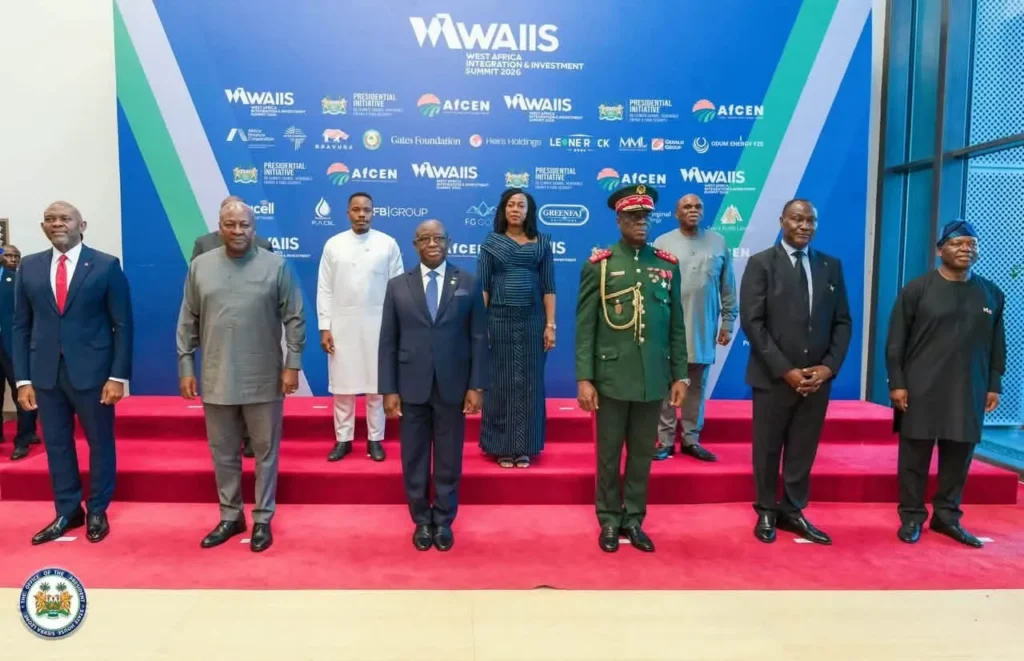
The West Africa Integration and Investment Summit (WAIIS 2026), whose main meetings took place on 17 and 18 November in Lungi, Sierra Leone, concluded with the signing of 13 agreements and seven announcements or project launches. Among the main initiatives were a partnership between Gento Group, Dangote Industries and Afreximbank involving the Banana Island deep-water port, new railway and logistics infrastructure, as well as several energy and industrial projects. The summit reflects West Africa’s ambition to mobilise capital and economic partners to accelerate the development of regional infrastructure.
A Portfolio of 122 Projects Estimated at $19 Billion
Organised as part of a programme scheduled from 16 to 18 November 2026, WAIIS brought together government representatives, financial institutions, investors and businesses at the Julius Maada Bio International Conference Centre in Lungi.
According to the closing report, 122 projects with an indicative value of approximately $19 billion entered the summit’s investment process.
This portfolio covers infrastructure, energy, mining, industry, telecommunications and financial services, among other sectors.
These figures represent the estimated value of the projects presented, rather than financing that has been fully mobilised.
At the closing ceremony, Julius Maada Bio, President of Sierra Leone, called on governments and businesses to move beyond declarations of intent and turn commitments into productive investments, jobs and tangible economic benefits.
Banana Island: A Partnership Between Gento Group, Dangote and Afreximbank
One of the summit’s main outcomes concerns the development of the Banana Island deep-water port in Sierra Leone.
A memorandum of understanding was signed between Gento Group of Companies, Dangote Industries and the African Export-Import Bank (Afreximbank) to advance a programme comprising three components:
- A deep-water port at Banana Island.
- A logistics platform at Kent.
- A railway connection linking the port facilities to the country’s mining regions.
The cost of the Banana Island port is estimated by its developer at approximately $2.7 billion. It forms part of a broader programme combining port and railway infrastructure.
This partnership builds on a project that had already progressed at the institutional level: in July 2024, Sierra Leone’s Parliament ratified a concession agreement with Gento Group concerning the development of the Banana Island port and the Kent logistics terminal.
The agreement announced in November 2026 therefore represents a new stage in mobilising partners around the project, rather than the creation of the project itself.
A separate agreement was also signed between Gento Group and Ghana Investment Bank concerning the development and financing of the Kent port terminal.
These infrastructure projects aim to improve connections between production areas, port facilities and regional and international markets.
At this stage, the announced agreements do not establish that all financing has been definitively secured or that construction work has begun.
A $600 Million Regional Economic Corridor
The summit also marked the launch of the Mano River Union Strategic Economic and Industrial Corridor initiative, involving four countries: Sierra Leone, Guinea, Liberia and Côte d’Ivoire.

This regional programme brings together five priority projects with an estimated value of approximately $600 million.
The sectors concerned include renewable energy, electricity transmission, port and logistics infrastructure, agro-industrial processing and the digital modernisation of customs procedures.
The initiative notably involves the ECOWAS Commission, the Mano River Union Secretariat, the United Nations Industrial Development Organization (UNIDO) and the WAIIS Secretariat.
Its objective is to strengthen cross-border trade, improve regional infrastructure and support the development of industrial value chains.
However, these five operations remain a portfolio of projects to be developed, with no confirmation that their overall financing has been definitively secured.
Roads, Electricity Networks and New Energy Capacity
Several other agreements directly concern the construction, civil engineering and infrastructure sectors.
Road infrastructure: Pavifort-AL Associates Group signed an agreement covering the Three Cities Development Project, as well as the modernisation of the Ring Road and its connections. The programme is estimated by its developer at approximately $2 billion.
Afreximbank and Pavifort also signed a term sheet for a revolving facility of up to $200 million, intended in particular for bid bonds, performance guarantees and letters of credit.
This stage does not yet constitute confirmation that financing has been definitively approved and disbursed.
Electricity infrastructure: Sierra Leone’s Ministries of Energy and Mines, Africa Finance Corporation (AFC) and LeoneVolt concluded an agreement to develop the Northern Transmission Corridor, particularly to improve electricity supply to mining operations.
Energy generation: another agreement concerns a 108 MW gas-fired power plant in Kissy, Freetown, developed by NANT Power. A separate memorandum of understanding covers the Teyei hydropower project, with an envisaged capacity of 25 to 40 MW, subject to feasibility studies.
These projects illustrate the complementary relationship between transport infrastructure, energy networks and industrial development.
African and International Partnerships to Mobilise Investment
The agreements presented at WAIIS 2026 demonstrate the growing importance of partnerships between businesses, governments and financial institutions in the development of African infrastructure.
The cooperation between Sierra Leone’s Gento Group, Nigeria’s Dangote industrial group and Afreximbank notably represents an example of African economic cooperation around a port and railway development programme.
Other initiatives involve development finance institutions and international partners to support the preparation and implementation of major projects.
This dynamic highlights a central challenge: turning regional economic ambitions into concrete investments requires adequately prepared projects, appropriate financing mechanisms and partners capable of mobilising the necessary expertise.
What Opportunities Exist for Construction Companies?
For African and Moroccan construction companies, engineering consultancies and equipment suppliers, the projects announced at WAIIS 2026 present several areas of interest.
Potential needs include port construction, railway infrastructure, roads, electricity networks, industrial facilities and logistics equipment.
Opportunity: interested companies will be able to monitor the progress of studies, the finalisation of financing agreements, the identification of project owners and the possible publication of procurement procedures.
However, the summit’s announcements do not, in themselves, constitute open tenders or awarded construction contracts.
Through these partnerships, Sierra Leone and its West African neighbours are pursuing a shared ambition: to strengthen regional economic integration by building the infrastructure needed for industrialisation, while connecting African projects with the capital and expertise that could support their implementation.
Sources
- WAIIS 2026 — Official Website of the West Africa Integration and Investment Summit
- A-Z Multimedia Corporation — Report on the 13 Agreements and Seven Announcements at WAIIS 2026
- CAJ News Africa — Investment Agreements and Infrastructure Projects, 19 November 2026
- Parliament of Sierra Leone — Legislative Report Confirming the Ratification of the Agreement with Gento Group in 2024
Editor’s Note: For any request for correction, clarification, amendment or any dispute concerning the information published in this article, please contact us at batimagcontact@gmail.com.
Bâtimag – The first Morocco–Africa platform dedicated to construction, public works, civil engineering, architecture and territorial development.
Inform. Connect. Develop.