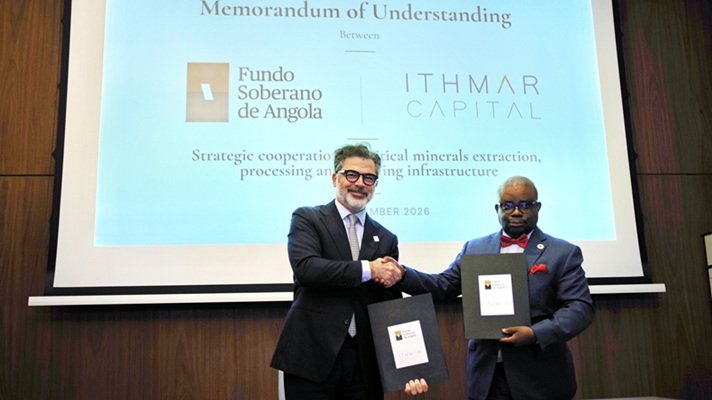
Morocco and Angola are strengthening their economic cooperation through a strategic partnership between Ithmar Capital and the Fundo Soberano de Angola (FSDEA). Announced on 19 November 2026, the agreement focuses on critical minerals, their industrial processing, and associated energy and logistics infrastructure. At the heart of this cooperation is the Lobito Corridor, a strategic route connecting Angola to the mining regions of the Democratic Republic of the Congo (DRC) and Zambia, with the ambition of strengthening African industrial value chains.
A Strategic Agreement Between Two African Sovereign Wealth Funds
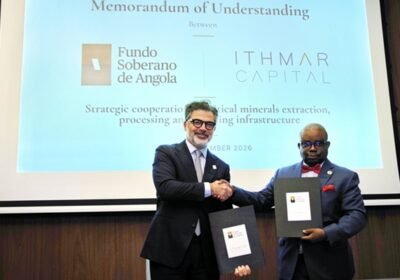
Ithmar Capital and the Fundo Soberano de Angola (FSDEA) signed a memorandum of understanding on the sidelines of the 18th Annual Meeting of the International Forum of Sovereign Wealth Funds (IFSWF), held from 11 to 13 November 2026 in Athens, Greece.
The agreement, made public on 19 November, was signed by Obaïd Amrane, Chief Executive Officer of Ithmar Capital, and Armando Manuel, Chairman of the Board of Directors of FSDEA.
The two institutions intend to mobilise their investment expertise, institutional capabilities and networks to identify, prepare and develop large-scale projects contributing to the industrialisation and economic diversification of the continent.
The cooperation focuses primarily on two areas: the extraction and processing of strategic and critical minerals, and the development of the energy and logistics infrastructure required for these activities.
These sectors are playing an increasingly important role in international supply chains, particularly due to the needs associated with the energy transition and industrial development.
At this stage, no investment amount or specific industrial project has been announced under this partnership. The memorandum establishes a framework for cooperation and does not, in itself, constitute a financing decision or the launch of a construction project.
The Lobito Corridor: A Connection Between Angola, the DRC and Zambia
The trans-African Lobito Corridor is a central element of the rapprochement between the two sovereign wealth funds.
This logistics infrastructure is structured around Angola’s Port of Lobito, located on the Atlantic coast, and the Benguela Railway, whose Angolan section extends approximately 1,300 kilometres to the border with the DRC.
The corridor connects the mining regions of Central and Southern Africa to international markets. It plays a role in transporting copper and cobalt, two important resources for several industries and technologies.
Zambia is also involved in the corridor’s development projects, with a new railway connection intended to improve access from its Copperbelt mining region to the Atlantic Ocean.
However, the objective extends beyond mineral transportation. The development of the corridor also aims to strengthen industrial infrastructure, logistics capacity and economic activities in the territories concerned.
Under the Morocco–Angola partnership, the stated objective includes promoting the processing of African natural resources within the continent before their transportation to international markets.
International Financing Already Mobilised for Infrastructure
The Lobito Corridor benefits from several investment programmes and financing operations that are independent of the new agreement between Ithmar Capital and FSDEA.
On 3 July 2026, Africa Finance Corporation (AFC) announced the financial close of a US$753 million transaction for the Angolan railway project.
According to AFC, this amount includes:
- US$553 million from the U.S. International Development Finance Corporation (DFC).
- US$200 million from the Development Bank of Southern Africa (DBSA).
This financing supports the rehabilitation, modernisation and long-term operation of the Angolan railway corridor under the Lobito Atlantic Railway (LAR) concession, a company involving, among others, the Portuguese group Mota-Engil and international commodities trader Trafigura.
One clarification is necessary: in a separate statement dated 31 July 2026, DBSA referred to a financial close of US$786 million. The amount of US$753 million presented here corresponds to the detailed breakdown published by AFC.
These financing operations concern the development of the corridor and do not constitute investments announced by Ithmar Capital under the new agreement.
Zambia Prepares a New Railway Connection
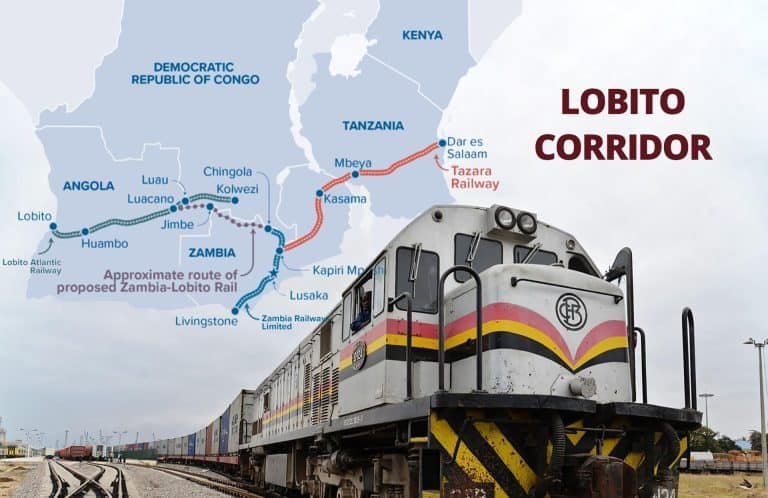
The development of the Lobito Corridor also extends to Zambia.
On 6 August 2026, the African Development Bank (AfDB) approved a US$255 million loan and a US$10 million grant to support Zambia’s participation in the development of the Lobito Economic Corridor.
The programme includes the construction of approximately 550 kilometres of railway lines in Zambia and the upgrading of 105 kilometres of roads between Mwinilunga and Jimbe.
It also includes trade facilitation measures, institutional capacity-building and skills development.
According to the AfDB, the programme could generate approximately 5,000 temporary jobs and 500 permanent jobs in construction, logistics and related services. These are projections, not jobs already created.
On 3 November 2026, Africa Finance Corporation also announced further progress in the preparation of the approximately 830-kilometre Zambia–Lobito railway link. Preferred bidders had been selected for the engineering, procurement and construction (EPC) contracts for the Angolan and Zambian sections, while financial close remained targeted for 2027.
These developments illustrate the corridor’s progress, while remaining separate from the memorandum concluded between the Moroccan and Angolan sovereign wealth funds.
Economic Impact and the Construction Sector: Infrastructure Needs Beyond Mining
The development of critical minerals does not depend solely on the extraction of natural resources.
Their industrial processing and commercialisation require transport infrastructure, energy facilities, logistics platforms and suitable industrial equipment.
For the construction, civil engineering and engineering sectors, programmes associated with the Lobito Corridor may therefore involve railway works, civil engineering structures, port infrastructure, electricity networks, industrial facilities and logistics equipment.
The modernisation of this infrastructure may also help reduce transport constraints and improve market access conditions for industrial and commercial companies.
The corridor thus represents an example of territorial development combining infrastructure, mineral resources, industrial processing and regional economic integration.
Morocco–Africa: Cooperation Focused on Investment and Industrialisation
The partnership between Ithmar Capital and FSDEA forms part of the Royal Vision for Atlantic Africa, explicitly mentioned in the announcement of 19 November.
It reflects a willingness to strengthen cooperation mechanisms between African sovereign investors around major development projects.
For Morocco, this agreement establishes a new framework for closer ties with Angola and, indirectly, with an economic area encompassing the DRC and Zambia, two important countries in critical mineral value chains.
For Angola, it forms part of an effort to diversify its economy and promote the industrial development of its resources.
This cooperation could eventually encourage closer ties between financial institutions, industrial companies and businesses specialising in infrastructure.
However, its concrete scope will depend on the projects actually identified, the studies carried out and the financing mobilised.
Opportunity: What Prospects for Moroccan and African Companies?
For Moroccan companies operating in construction, civil engineering, industrial engineering, energy equipment and logistics, the rapprochement between Ithmar Capital and FSDEA represents, above all, an institutional initiative to monitor.
The next important steps will concern the identification of projects envisaged by the two funds, potential feasibility studies, investment decisions and the arrangements for economic operators to participate.
At the same time, companies interested in the Lobito Corridor can monitor the railway and logistics programmes already under way through the relevant project owners, concessionaires and financing institutions.
No open tender or contract awarded to a Moroccan company under the new Ithmar Capital–FSDEA agreement has been identified in the publicly available information reviewed.
The challenge now will be to determine the extent to which this financial cooperation can contribute to the implementation of new industrial and infrastructure projects, while strengthening economic exchanges between Morocco, Angola and the other African markets concerned.
Sources and References
Morocco–Angola Agreement:
- Médias24 — Ithmar Capital and Angola’s Sovereign Wealth Fund Partner on Critical Minerals, 19 November 2026
- Le Desk — Ithmar Capital Partners with Angola’s Sovereign Wealth Fund, 19 November 2026
- Le Matin — Critical Minerals: Ithmar Capital and Angola’s Sovereign Wealth Fund Join Forces, 21 November 2026
Corridor Infrastructure and Financing:
- Africa Finance Corporation — US$753 Million Financial Close, 3 July 2026
- Development Bank of Southern Africa — Railway Project Financial Close, 31 July 2026
- African Development Bank — Financing for the Lobito Economic Corridor in Zambia, 6 August 2026
- Africa Finance Corporation — Progress on the Zambia–Lobito Railway Project, 3 November 2026
Editor’s Note: For any request for correction, clarification, modification or any dispute relating to the information published in this article, please contact us at batimagcontact@gmail.com.
Bâtimag – The first Morocco–Africa platform dedicated to construction, civil engineering, architecture and territorial development. Inform. Connect. Develop.